§ Industry · InsuranceExecutive brief · REG-INS-2026.09

One carrier group. The whole book of work, run as a back office.

Money in, money out, and the trust layer around both. Five walkthroughs at one fictional carrier group — a 1035 exchange, term-life new business twice over, a death-claims desk, and the guardrails a security reviewer walks through — every one captured live from a real run. The platform does the work: intake, extraction, verifying against the register, noticing what is missing, drafting the ask, sending it over real email, chasing on the policy cadence, resuming when the reply lands, issuing the letter, writing the disposition back. People make decisions: approve an outbound message, adjudicate above authority, and whatever the compliance policy says a person must review. Nothing else.

27 days

Average time to a final decision under traditional life underwriting — cut to nine with automated / accelerated programs. Most of those weeks are the gaps between steps, not the decisions themselves.

LIMRA · 2020
§ 01 — The book of work

Three arcs. One engine. Every number measured.

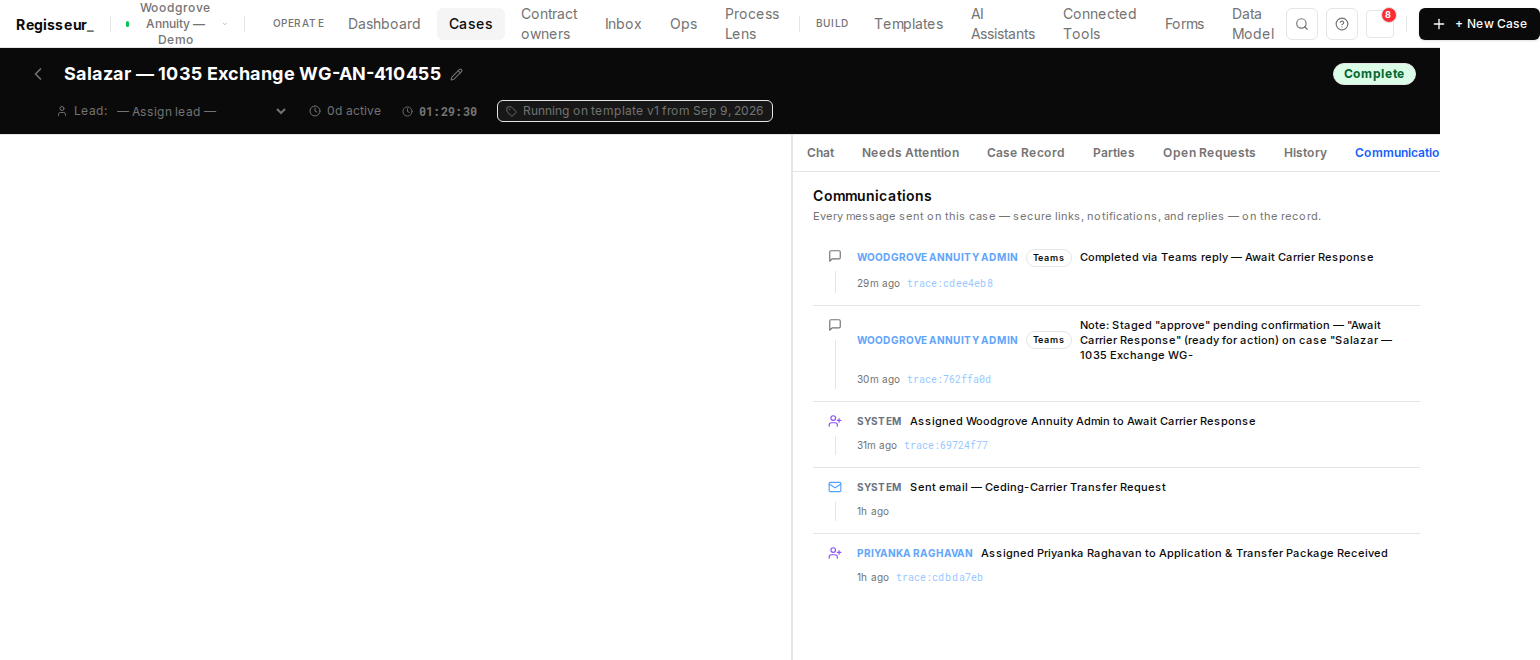
Salazar’s completed 1035 exchange — the case marked Complete, with the Communications tab recording the close via a real Microsoft Teams reply.
§ Money in

New business that chases, waits, and hands off when it should.

A 1035 exchange arrives complete and issues straight through; one arrives with the disclosure unsigned, and the platform finds the gap, drafts the request, a person approves it, the owner signs for real, the case issues; one ceding carrier never answers, four reminders go out on the policy cadence, and a real person closes the case from a Microsoft Teams message. Term life runs the same way — three applicants, three different answers, a human underwriter’s sign-off before anything issues, and a self-serve path from a public website to policy in force.

MeasuredStraight-through 1035: 4 human touches (3 policy-mandated) · 0.7 human minutes · 317 s case. Silent carrier: 4 chase reminders sent unattended · closed from Teams. Self-serve term life: 10 real emails · 1 human approval.
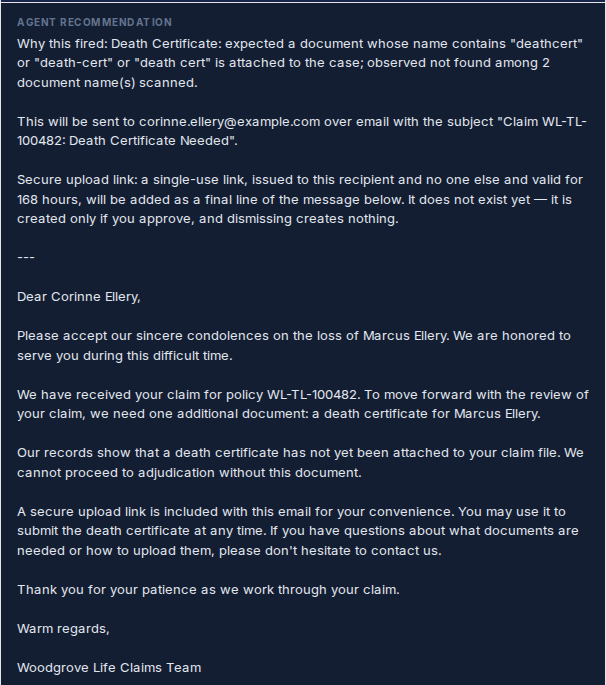
The platform’s drafted request for a missing death certificate — its reasoning, the recipient, and a single-use secure upload link, held for human approval before anything is sent.
§ Money out

A claims back office that runs itself.

Three death claims. One arrives complete and settles. One is missing the death certificate: the platform notices, drafts a considerate request, a person approves it, it goes out over real email, the beneficiary uploads through a secure link, and the case resumes on its own. One beneficiary never replies: four reminders on the policy cadence, then escalation to a person — the case left honestly open, not quietly closed.

MeasuredStraight-through: 1 review · 45.5 s human · 121 s case. Missing document: 2 decisions · 43.3 s human · 177 s case. Silent beneficiary: 4 chase reminders sent unattended · 0 manual follow-ups.
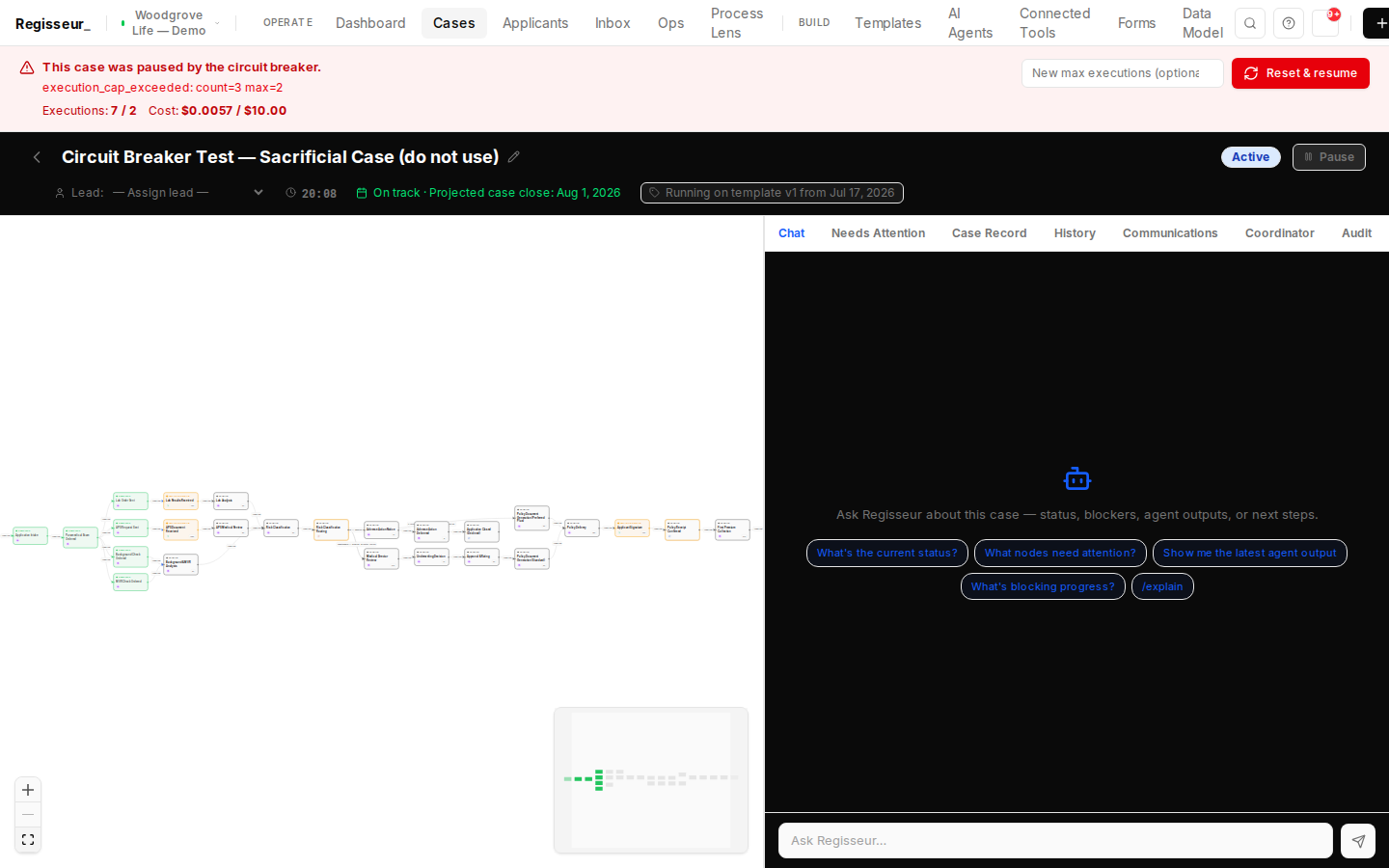
A Woodgrove Life case paused by the circuit breaker — the red banner shows the exceeded execution cap and the reset-and-resume control.
§ Trust

Why compliance can let agents near a case.

A security reviewer’s walkthrough of the guardrails around every agent: an eval suite scored by a blind-calibrated judge, drift caught against run history, a per-case circuit breaker tripped and reset live, the workspace-wide Emergency Brake pulled and released, and one log where every safety action lands on the record — captured live, including what was found and fixed along the way.

Measured6 test scenarios behind one agent · 2 models compared with real cost · 2 independent safety limits, both tested · 41 timestamped events on one case, exportable.
§ 02 — Labour vs. decisions

The claim is measured, not narrated.

Every human touch in a run is classified — policy-mandated (a feature) or a platform limitation (a carve-out, named as such) — and the ledger keeps the time a person spent deciding separate from the time the case stayed open. This is that ledger for the two back-office runs, straight from the run manifests.

CaseHuman touchesHuman timeCase wall-clockChases sent unattended
Annuity · arrives complete4 (3 policy-mandated)0.70 min317 s0
Annuity · disclosure unsigned5 (4 policy-mandated)0.69 min0 · 1 real signature
Annuity · carrier silent3 (2 policy-mandated)0.59 min4, unattended
Claims · arrives complete1 review45.5 s121 s0
Claims · certificate missing2 decisions43.3 s177 s0
Claims · beneficiary silent1 decision16.1 sopen4, unattended

Chase cadences time-compressed for recording; fictional identities; outbound email routed to a stand-in inbox. Each report names its own gaps on the page.

§ 03 — Term life, application to issuance

The path of a case.

A term-life case rarely stalls because the work is hard. It stalls waiting — on an APS nobody is chasing, on labs that came back to an unwatched inbox, on a NIGO application bounced for a missing signature. Regisseur chases the evidence, works the review gates, and moves the case from intake to issued.

Stage
01
Intake
ACORD 103 normalized; applicant identity resolved; duplicate check.
Agent · graduated
Stage
02
APS request
Tokenized link to physician; TTL 72h; escalation cascade on timeout.
Agent · graduated
Stage
03
Paramed & labs
Schedule, confirm, reconcile. Examiner no-show triggers Recovery Path.
Agent · graduated
Stage
04
UW summary
Drafted from evidence. Confidence below threshold halts for sign-off.
Human · always review
Stage
05
Replacement review
NAIC-BI enforced at engine level. Disclosure pack assembled.
Human · always review
Stage
06
Policy issue
Documents generated with citations; signing portal pauses and resumes the cascade.
Agent · graduated
Stage
07
Conservation
Lapse-risk signals monitored; retention outreach triggered at threshold.
Agent · graduated
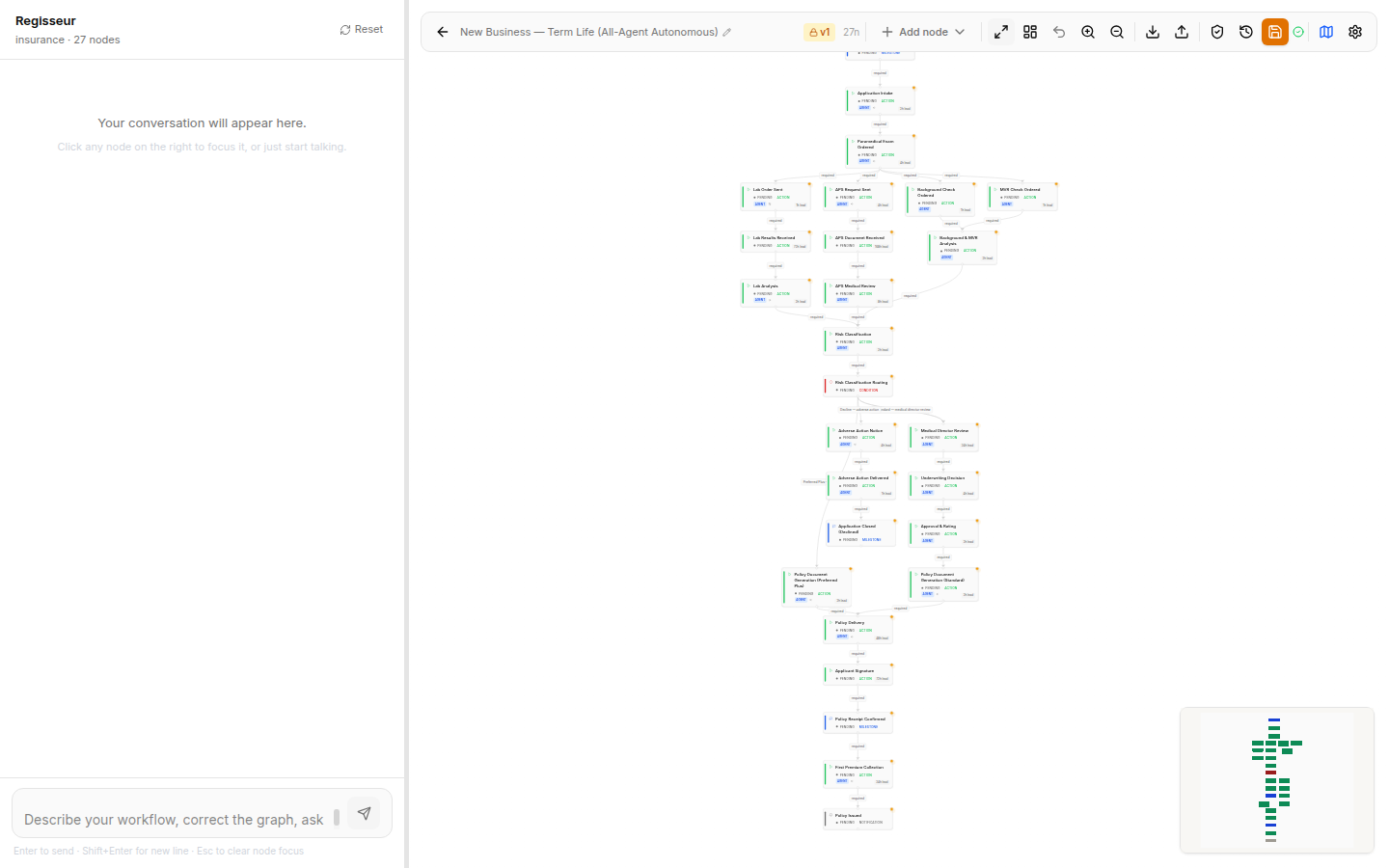
The 27-node term-life flow in the graph builder — typed action, condition, and milestone nodes with parallel Lab, APS, Background, and MVR evidence branches and agent and form badges.
The authored flow27 nodes — parallel Lab, APS, Background, and MVR branches, with agent and form badges
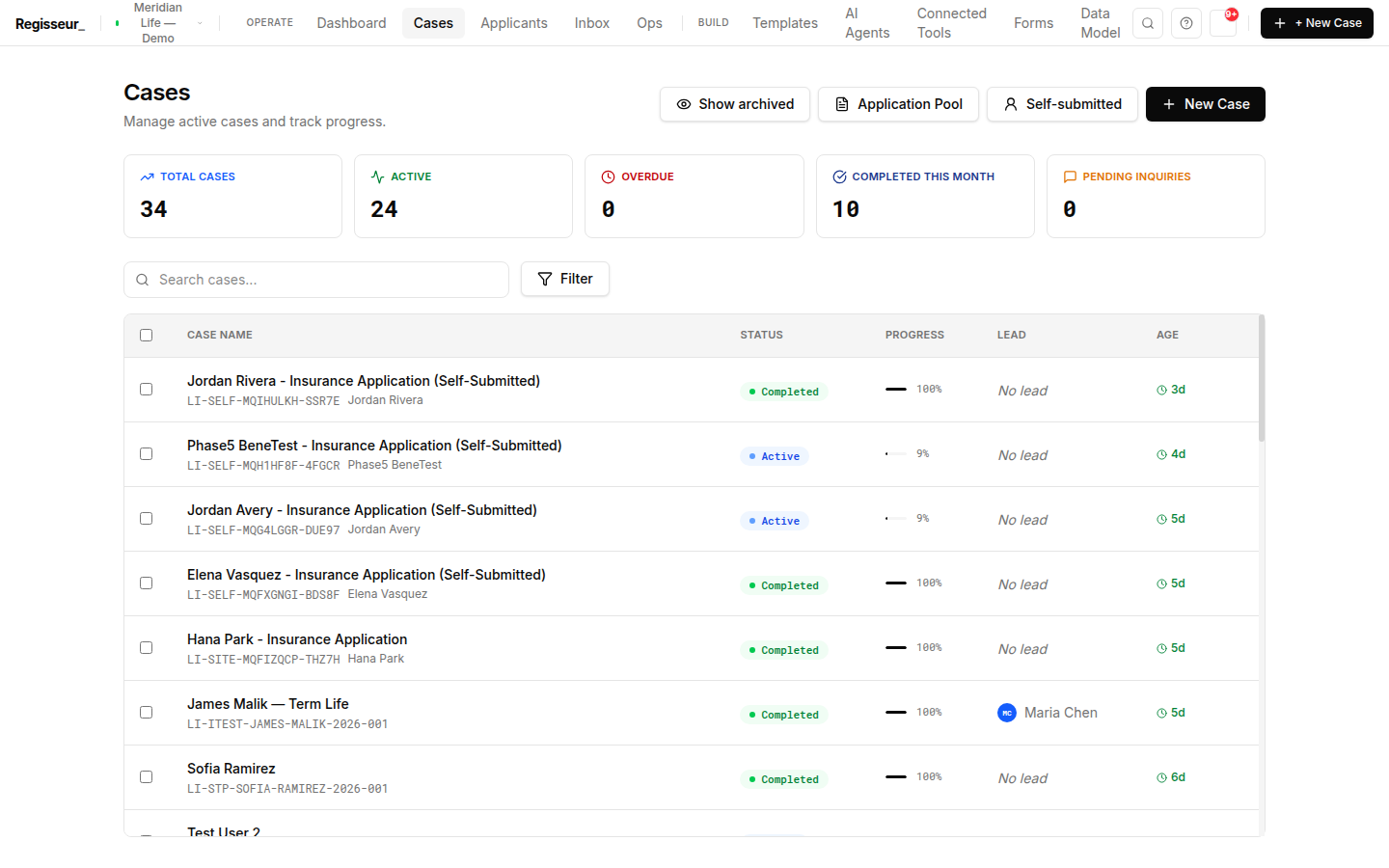
The Cases workspace — 34 total, 24 active, and 10 completed KPI tiles and a real case table with status, progress, lead, and age.
The live caseload34 cases — KPI tiles and a real case table with status, progress, and age
§ 04 — What changes for the carrier

More cases closed. Same ops team. Cleaner audit.

  • For the COO

    I’m judged on cycle time, and I can’t see where the days go. A case sits for a week because an APS never came back and no one was watching the clock. Give me predictable turnaround and a causal record for every exception — so when a case is late, I know exactly why, not just that it is.

  • For the Head of Underwriting

    My underwriters are expensive judgment, and half their day goes to chasing labs and re-requesting missing forms. I don’t need them faster at data entry. I need their attention on the risk — with everything around that decision gathered, checked, and waiting before they open the file.

  • For the Head of Claims

    Most of a claim is waiting: for a certificate, for a beneficiary to answer, for someone to notice nobody has. I want the platform to do the noticing and the asking, and to bring me the one decision that is actually mine — with the file already complete when it does.

  • For the CIO

    I’ve been burned by rip-and-replace. This overlays the systems we already run — policy admin, the evidence vendors, e-signature — with no migration. It reads and writes through the integrations we have, so nothing underneath changes and there’s no new system of record to reconcile.

  • For Compliance

    When the regulator asks why a case was handled the way it was, I need more than a story. NAIC replacement rules enforced by the engine, not by training. Every case re-runnable, every decision attributed, every disclosure on the record — an audit answer I can actually stand behind.

§ Next step

Your next 10 NIGO cases, run through Regisseur.

Redacted week of intake; 45-minute walkthrough. We’ll show you the same cases moving — with SLA clocks, AI drafts, human sign-off, and the audit trail all in view.

Book the walkthrough Read the governance model
Audience
Carriers · TPAs · MGAs · program administrators
Commercial
Annual · per deployment · usage-sized
Time to live
Weeks, not months