§ 01 — The question every board is asking

The AI pilot worked.
Why isn’t it running your operation yet?

You’ve already invested in AI. Models that classify, score, summarize, and respond. Some of them are good. None of them are running your operation.

That gap is not an accident. It is the wall every regulated enterprise is hitting right now.

See how operations cross the wall
§ 02 — Why the wall exists

AI doesn’t graduate to production
without the scaffolding
production requires.

A model can reason. It cannot, on its own, take ownership of a case, follow a defined process, escalate to the right human, get reviewed, get versioned, or get audited. Without that scaffolding, your AI cannot ship into the operation. With it, the same model becomes a working teammate.

See the scaffolding
Regisseur agent execution pipeline showing READ, MCP CALL, LLM REASONING, and WRITE step types for an underwriting agentRegisseur agent configuration screen showing deterministic execution pipeline steps
Seven steps. LLM is one of them.The pipeline itself is predictable and auditable.

AI teammates succeed the same way human teammates do. They need a defined role in a defined process.

§ 03 — What changes

Turn your AI investment into operating capacity.

With that structure in place, AI stops being a pilot and starts being capacity. Your team runs more cases, closes more files, serves more customers, under the same rules they already work by.

Regisseur Energy Access Request Demo workspace showing AI agent metrics and agent cards with Ripcord badgesRegisseur Energy Access Request Demo workspace showing AI agent metrics and the first row of agent cards
Fourteen AI teammates running an enterprise operations workflow.Each with a role, a ceiling, and a brake.
  1. 01Production AI that pays back the investment.
  2. 02Agents take roles in your process: reviewing submissions, validating policies, coordinating approvals. Case volume goes up. Headcount stays flat.
  3. 03Audit, ceiling, and brake built in, so AI ships instead of stalling in legal review.

Production AI is the new competitive advantage.

~20%EBITDA uplift reported from well-executed AI transformations.McKinsey & Company
Book a 45-minute walkthrough
§ 04 — Why it reaches production

Verify the agent before
you trust it to run.

An agent earns the right to run the way a teammate does — by proving itself first. Regisseur verifies every agent on the axes that decide whether it can be trusted, then lets it run only as far as the proof allows.

Proven before it runsSee the eval suite
  • AccuracyGraded against expected outputs and rubrics.
  • PerformanceLatency measured at p50 / p95.
  • Cost$/run — the cheapest model that still passes.
  • ReliabilityRated against a saved baseline; drift can block the change.

AI agents need a stage. Every stage needs a Regisseur.

A stage manager keeps every performer and every cue in sequence. Regisseur is the System of Action where AI agents and humans turn operational signals into assigned, executed, reviewed, and recorded work.

Book a walkthrough See how it stays governed
Sits above Systems of Record and Insight.
Live in weeks, not months.
§ 05 — The missing layer

Records hold what happened. Insights show what matters. Regisseur acts.

SYSTEM OF ACTIONRegisseur

The governed surface where signals become assigned, executed, reviewed, and recorded work.

ProcessToolsAgentsIntegrations
SYSTEMS OF RECORDHold what happened

Authoritative operational history. Unchanged, not replaced.

ERPCRMTMSDocument storeCore database
SYSTEMS OF INSIGHTShow what matters

Analytics, forecasts, scores, and signals that inform the next move.

BIAnalyticsForecastingMarket dataScorecards
§ 06 — How it works

Four configurable primitives. One operating surface.

01

Process

The steps, states, handoffs, deadlines, approvals, and recovery paths that define how work actually moves.

02

Tools

The bounded capabilities agents and humans can call: read, write, transform, notify, sign, escalate, or verify.

03

Agents

AI teammates with versions, ceilings, input contracts, output schemas, and explicit ownership inside the process — each with an eval suite that proves it works on the cheapest model that still passes.

04

Integrations

Connections to systems of record through scoped provider and MCP contracts — not unbounded access.

§ 07 — Where the work happens

Where the team and the process come together.

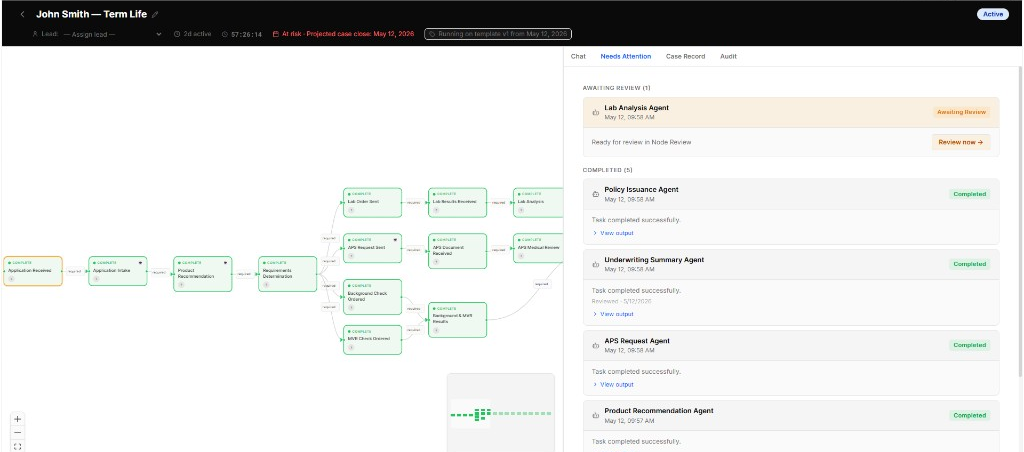
Every case has a process on the left and a team working it on the right. Some teammates are people. Some are agents. They share the same record, the same rules, and the same next decision.

Read the operational reality
Regisseur case workspace showing a process graph, agent task status, and a human review queue
A single case in flight.Process steps on the left, agents and humans on the right, every action a record.
§ 08 — What the platform does

The team, the process, and the next decision stay in one frame.

In McKinsey’s terms, this is the split between functional agents that run domain tasks and enterprise agents that oversee work end to end — and flag low-confidence decisions for human intervention. McKinsey, The AI assembly line (May 2026)

01Team Layer

Coordinates the team

Humans and agents share ownership of the same operational process. Every task has an accountable owner, an autonomy ceiling, and an escalation path.

  • MembersHuman + AI
  • OwnershipNamed
  • EscalationExplicit
02Execution Layer

Executes deterministically

The process runs as typed, repeatable steps. AI reasoning is one bounded tool inside the process, not the process itself.

  • StepsTyped
  • ToolsBounded
  • ChangesVersioned
03Decision Layer

Surfaces the next decision

The next action arrives with context, confidence, lineage, and the reason it needs a human or agent owner. The why travels with the work.

  • ContextComplete
  • LineageAudit-linked
  • ConfidenceVisible
§ 09 — The category, validated

McKinsey named the orchestration layer. Regisseur ships it for regulated industries.

In The AI assembly line, McKinsey describes the enterprise’s target state as an agentic orchestration layer — one that “acts as the conveyor belt … managing the flow of tasks, decisions, and data across the organization.” Regisseur is that layer — built with the audit trail, autonomy ceilings, and human gates a regulated enterprise needs to put it into production.

McKinsey & Company, The AI assembly line: Strategic imperatives for CEOs (May 2026)

Runs in your boundary

Your keys. PHI masked. Data never leaves your environment.

McKinsey lists anonymizing data before model input among enterprise requirements; in Regisseur it is the default deployment, not an add-on.

§ 10 — Safe to deploy

Seven structural guarantees. Before the first process goes live.

S.01

Audit trail on every decision

Reconstruct any work item — what happened, who decided, on which version of the rules.

S.02

Regulatory versioning

Past work remains re-runnable on the exact forms and agents that were live when the process started — even after rules change.

S.03

Configurable autonomy ceilings

Every agent operates within a ceiling set by operations — always review, graduated, or fully autonomous. The agent cannot exceed it.

S.04

Deterministic processes

Agents run typed, repeatable process steps. AI reasoning is one step — not the driver.

S.05

Workspace-wide emergency brake

One action pauses every agent, queue, and outbound message across the platform.

S.06

Configurable without engineers

Process managers build and adjust operational processes in conversation — not sprints.

S.07

Rehearsed before trusted

Run any agent against a real scenario with the outside world mocked, and inspect every step before it goes live. Optionally gate publishing on a passing eval — a draft can’t ship until it proves itself against that exact version.

You never trust the AI. You bound it with deterministic boundaries — then replay exactly what it did.

Govern before, verify after
§ 11 — Test before trust

Test the work before the work is real.

Every Regisseur agent runs as a deterministic pipeline — the same inputs take the same path every time. So you can run an agent against a real scenario with the outside world mocked, and watch the whole decision unfold before you let it act.

Pick a scenario. Run the agent once. The outside world is stubbed — no email leaves the building, no record is written, no external system is called — but the agent reasons for real. You get back the full trajectory: every step it took, every tool it reached for, which branch it chose, and what each step returned. Mock any step’s result yourself to rehearse the unhappy paths you can’t trigger on demand — the rejected claim, the missing document, the check that fails.

When you’re ready to ship, turn on the eval gate. Now a draft can’t go live until it passes its tests — and the pass has to be for that exact draft, not an older version that once worked. The quality bar becomes part of deploying, not a separate step someone remembers to do.

Regisseur simulation trajectory: a medical-review-prep agent run in dry-run mode, showing each step's type, the tool it called, the branch it took, mock-applied side effects, durations, and outputs
One agent, one scenario, run dry.Every step, every branch, every mocked side effect — inspectable before go-live.
01

Dry-run, for real

Run a live scenario with no side effects — no emails, no writes, no API calls. The agent reasons exactly as it would in production; only its outward actions are stubbed.

02

Watch the trajectory

A step-by-step trace of what the agent decided and why — each step’s type, the tool it called, the branch it took, the output it produced. Nothing hidden in a black box.

03

Mock the world

Stub any step’s result to rehearse the paths you can’t trigger on demand — the rejection, the missing field, the failed check — before a customer hits it.

04

Gate the deploy

Switch on the eval gate and a draft can’t publish until it passes — verified against that exact draft, not a previous version. Tested before trusted.

RPA records a click. Regisseur lets you rehearse the entire decision — and blocks the ones that fail.

Regisseur · Simulation · Dry-run · Eval-gated publish
§ 12 — Why the scaffolding matters

RPA breaks on judgment. LLMs break on accountability.

RPA cannot adapt when the work requires judgment. Agent frameworks can reason, but they do not provide causal audit, runtime compliance, autonomy ceilings, or an emergency brake. Regisseur is the production scaffold for operating AI in real workflows.

ApproachCognitive adaptabilityCausal auditRuntime complianceAutonomy ceilingEmergency brake
Legacy RPANoneLogs onlyOffline policyN/AManual
LLM-on-RPA bolt-onYesOpaquePolicy driftNoNo
Agent frameworkYesTool logsDeveloper effortPrompt-levelNo
RegisseurYesAppend-only · replayableTier 1 · enforcedEngine-level · earnedWorkspace-wide

LangChain builds the agent. Regisseur is the production scaffolding required to operate it. For a deeper comparison with LangChain specifically

§ 13 — Capabilities, in action

Five demos. One engine.

Regisseur runs the same way whether the process is months long or minutes long, regulated or operational, triggered by a phone call or a webhook. Five operations we can walk through live, in one workspace.

Demo walkthrough: life insurance underwriting

Regulated decisioning, end to end

Application intake through APS, lab analysis, underwriting summary, and policy issuance. Every underwriting decision reviewed by a human. Everything between them runs as a chain of agents under explicit autonomy ceilings.

Human gateMedical review, underwriting approval, policy issuance.
SystemsDocuSeal · external party portals · custom underwriting forms.
Watch this demo
Demo walkthrough: enterprise employee onboarding · HRIS-triggered

Cross-system onboarding, zero tickets

A new hire record in the HRIS becomes a provisioned, welcomed, closed-out employee in minutes. Six agents chained: intake, access planning, equipment provisioning, IT access, welcome package, HRIS writeback. One manager review on the access plan; everything else autonomous.

Human gateManager approval on the access plan.
SystemsHRIS · Active Directory · Azure AD · IT asset management.
Watch this demo
Demo walkthrough: employee offboarding · HRIS-triggered

Departure closure, no loose ends

An HRIS termination event becomes a fully revoked, closed-out departure. HRIS intake → IT footprint analysis → access revocation across AD, Azure, and applications → M365 data transfer → compliance review → HRIS writeback.

Human gateIT footprint review. Compliance sign-off before HRIS writeback.
SystemsHRIS · Active Directory · Azure AD · M365.
Watch this demo
Demo walkthrough: IT access requests · ServiceNow-triggered

Compliance-bounded approvals

A ServiceNow ticket becomes a structured policy decision. An agent reads the request, fetches the user's AD profile, reasons against SOX and ISO 27001, and hands the manager a recommendation before they ever see the raw ticket. After approval, provisioning runs across AD, Azure AD, and the target application simultaneously.

Human gateManager approval, with policy reasoning pre-attached.
SystemsServiceNow · Active Directory · Azure AD.
Watch this demo
Demo walkthrough: IT incident management · ServiceNow-triggered

Plan-before-action incident response

A ServiceNow incident is classified against the CMDB and knowledge base. A remediation plan is built and reviewed by a tech lead before anything changes in production. Once approved, remediation runs through Intune and the closure writes back to ServiceNow. Mean time to resolution drops because diagnostics happen while the human reviews a finished plan.

Human gateTech lead approves the remediation plan before execution.
SystemsServiceNow · CMDB · Intune.
Watch this demo

Five operations. Same primitives. The vertical is configuration.

§ 14 — Deployment-ready operations

Not just configurable. Deployable, testable, and promotable.

D.01

Workspace providers

Mail, messaging, signing, and error reporting resolve per workspace. Admins test connections; every write is ledgered.

D.02

Signing as a process pause

A process can halt on an external signature, render a token-gated signing portal, then resume the cascade on completion.

D.03

On-prem capable data plane

Local Postgres, storage, queue, and DocuSeal support regulated evaluations without a hosted product data plane.

D.04

Signed vertical bundles

Workflow templates, agents, forms, documents, and tools move between workspaces as audited operational packages.

The product story now extends past orchestration: Regisseur can configure the workspace, prove the provider path, and package the vertical.

See the deployment model
§ 15 — How the work splits

Seamless human–AI teams. Bounded by design.

Agent team · Humans
Judgment & escalations
  • FocusComplex work
  • OwnsOperational outcomes
  • WorkExceptions · approvals · decisions
  • SpeedValue-added · no re-keying
AI team · Bounded agents
Orchestration & follow-up
  • OrchestratesFollow-up loops and tool calls
  • ApprovalsMandatory human sign-off where required
  • FlagsLow-confidence → human owner
  • NeverOverrides autonomy ceiling
§ 16 — Start a workspace

A 45-minute walkthrough.
Your process, configured as a team.

Bring one operational process with human judgment, system data, and repeatable follow-up. We’ll map the process, the tools, the agents, and the first review gates.

Book the walkthrough See process design
Contact
ross@regisseur.ai
Web
regisseur.ai
Commercial
Workspace · team · process deployment
Classification
Platform overview · confidential