01Describe
Describe the work.
"When evidence is outstanding after 72 hours, chase the owner; after 48 more, escalate to the lead."
Human teams describe the process in plain language. Regisseur turns it into typed steps, bounded tools, agent roles, review ceilings, SLA clocks, recovery paths, and versioned promotion.
"When evidence is outstanding after 72 hours, chase the owner; after 48 more, escalate to the lead."
Choose which humans own exceptions, which agents handle repeatable work, and where the handoff must stop for review.
Allowed tools, schemas, rate limits, review gates, and ceilings are explicit per step.
Replay past work against the draft. Diff the behavior. Promote to production with an immutable version tag. Roll back any time.
Describe a step and an AI assistant drafts the pipeline. Dry-run each agent against real fixtures before you deploy it, and when you change a template, in-flight cases migrate forward safely, completed steps preserved.
Each node is typed (action, condition, or gate) with an owner, a lead time, and a live state. Work fans out into parallel branches and converges through review gates: one versioned model the team builds and runs.
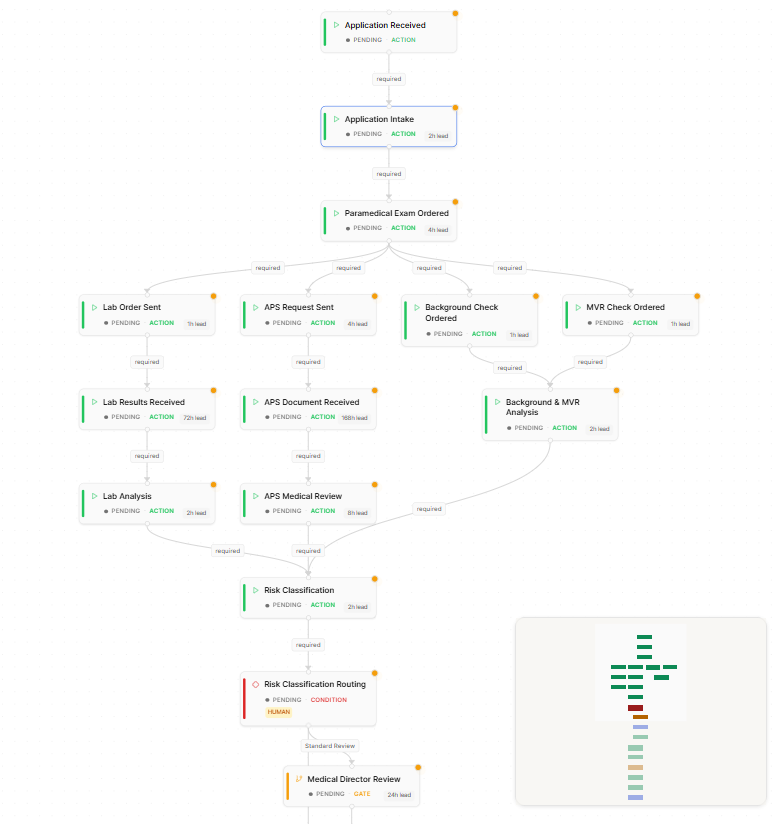
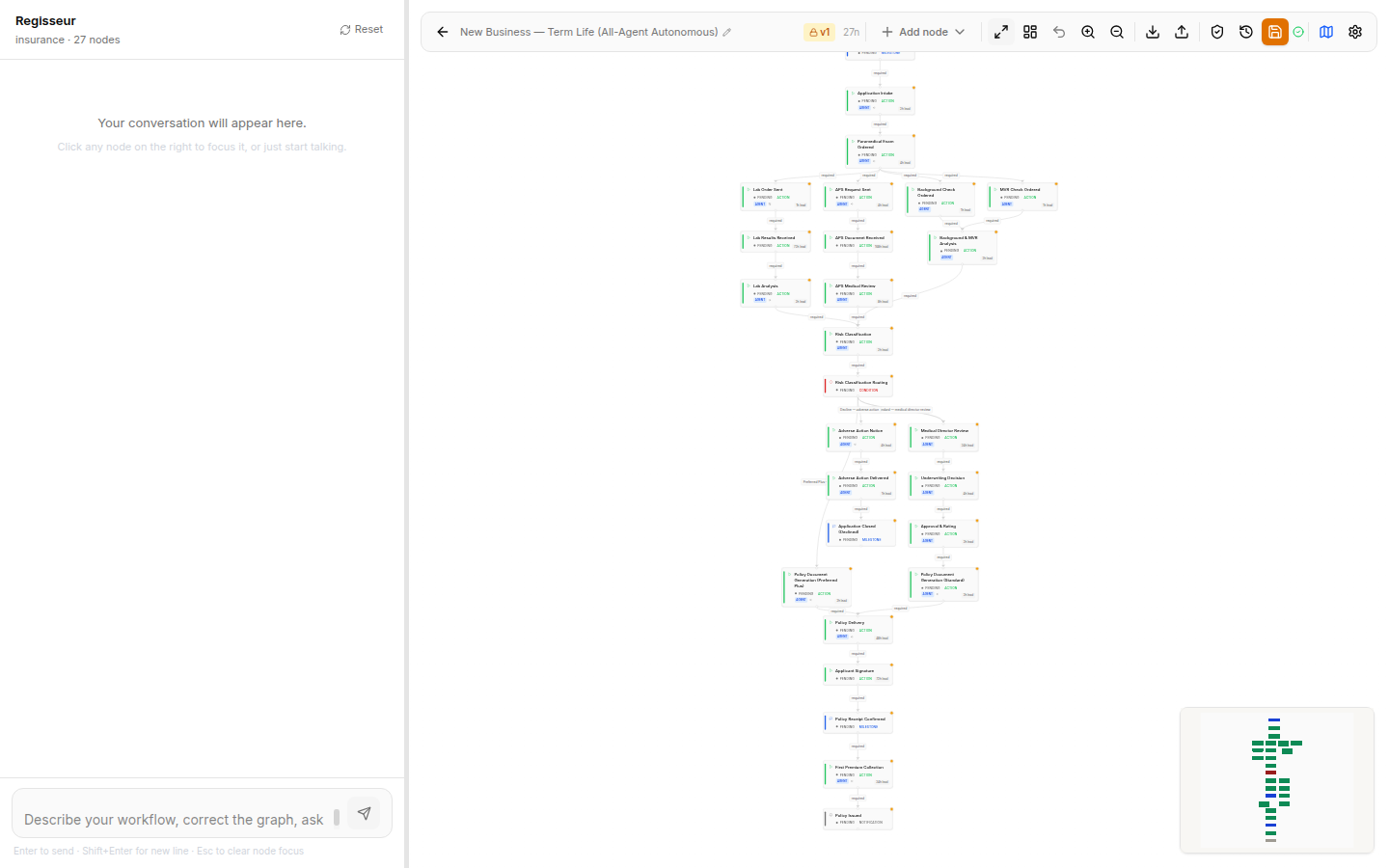
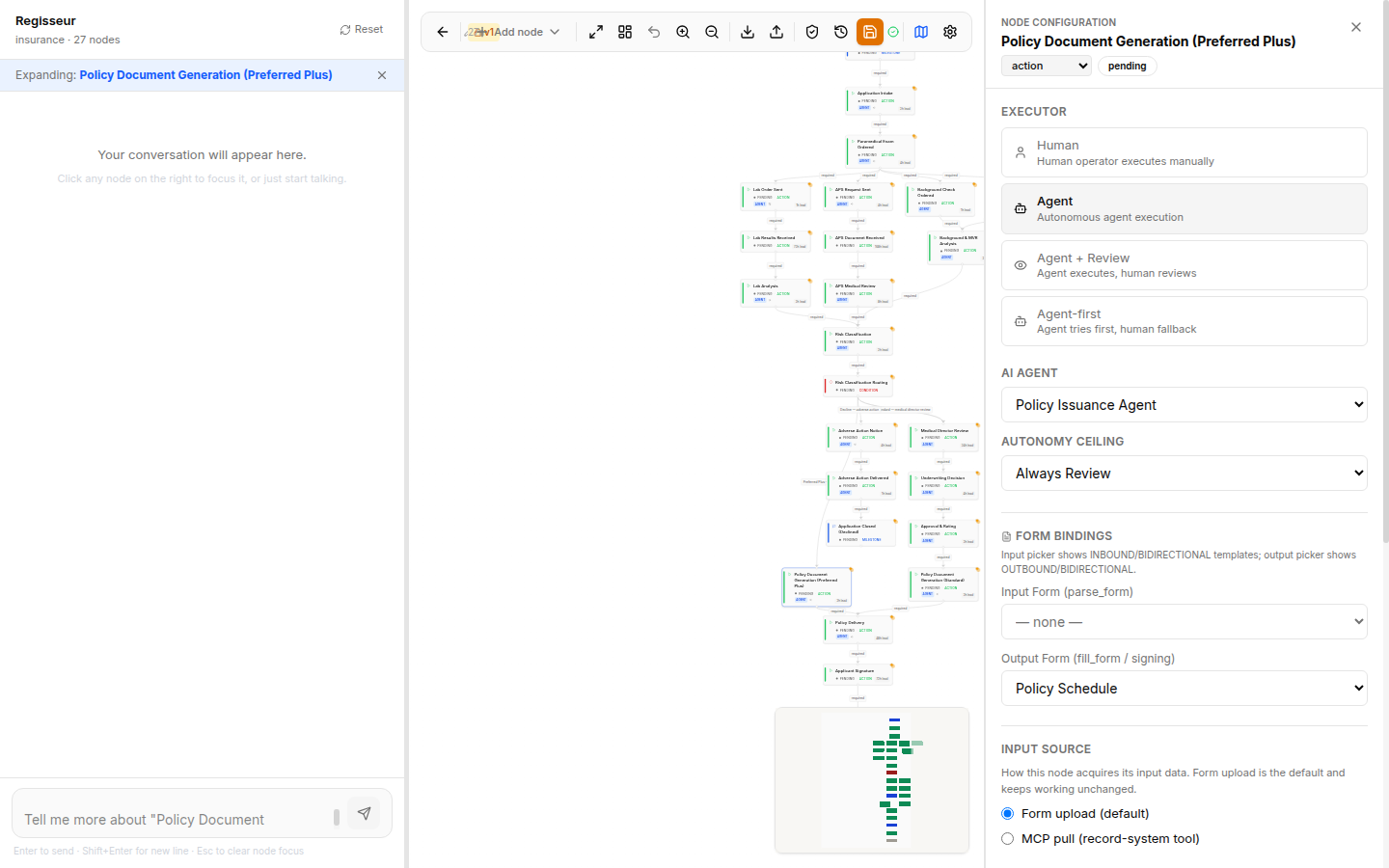
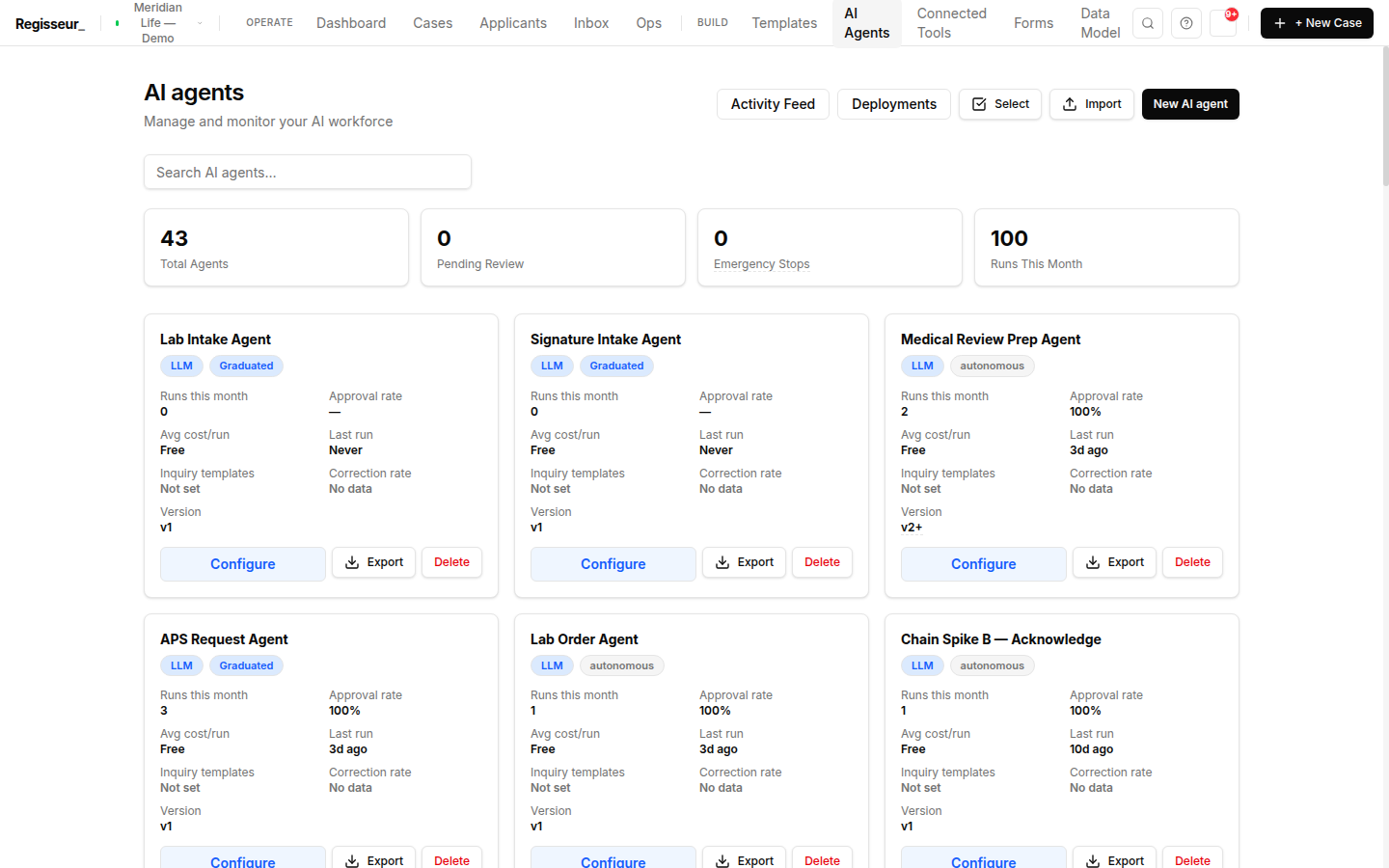
The process lead defines the agent’s job, allowed tools, review ceiling, handoff conditions, and the exact events that wake it up. The agent is a teammate inside the process model, not a free-floating bot.
Evidence packet missing for 72h → assign to Evidence Chaser.
Dry-run against recent work and show items that change behavior.
Promote agent assignment with version, owner, and rollback path.
The process reaches a signing step and creates the provider envelope with work-item lineage attached.
The node moves to awaiting signature. Operators see it as a queue state, not an exception.
The signer gets a purpose-specific link. No platform account is created for external parties.
The completion webhook stores the signed PDF, updates the ledger, and wakes the next step.
Work opened under v3.4 keeps running under v3.4, even after v3.5 ships. The only way to change history is to re-open the work item.
Every promotion is a signed, dated release. Every rollback is a revert, not a delete. When an auditor asks what the system did on a Tuesday in March, we can answer with the exact process, rule versions, agent assignments, and tool definitions that were live that day.
Bring one open requirement loop: we’ll describe it, scaffold it, run a dry-run against real data, and show you the diff. 45 minutes, no slides.