Mail
SMTP default · Microsoft Graph · SendGrid
Invitations, follow-ups, and signing links use the workspace-selected mail path.
Test connectionEvery external interaction flows through a registered, workspace-scoped tool or provider: revocable, testable, and audited at the call site.
Regisseur reads documents, records, tickets, and work items through registered tools. Source systems stay authoritative.
Every retrieval is an audited MCP call; every token is workspace-scoped and revocable.
Regisseur normalizes domain payloads into typed work attributes for downstream steps.
Payload lineage is preserved end-to-end. Every derived value links back to its source field.
Domain rules compile into process gates. Violations fail closed and cite the blocking criterion.
Rules are versioned. In-flight work finishes on the rule set that was live when the work started.
| Server | Purpose | Scope | Auth | Status |
|---|---|---|---|---|
| document.system | Workspace document retrieval | Workspace · read | Service token · rotated 30d | Live |
| structured.intake | Typed intake payload ingestion | Workspace · write | Mutual TLS | Live |
| rules.engine | Domain rule lookup and validation | Org · read · versioned | Service token | Live |
| calculation.service | Scored recommendations and calculations | Workspace · read | Service token | Live |
| twilio.outbound | Tokenized SMS to external parties | Workspace · write · signed | Signature verification | Live |
| signing.provider | Embedded signing envelopes and PDFs | Workspace · write | Provider credential | Live |
| system.writeback | Approved outcome writeback | Workspace · write | Service token · 2-factor | Staging |
Invitations, follow-ups, and signing links use the workspace-selected mail path.
Test connectionSMS and gateway delivery stay bounded by a provider contract and signed outbound call model.
Test connectionEmbedded signing creates an auditable pause and resumes the workflow on completion.
Test connectionOperational evidence can route to the customer-approved reporting provider.
Test connectionSystems of record, document stores, CRMs, ticketing queues, billing systems, and data warehouses stay put.
Regisseur reads what it needs, writes what it’s allowed, and leaves the rest alone. Domain experts update Tier 2 agent logic; the Tier 1 engine stays locked; Tier 3 packages carry domain rules.
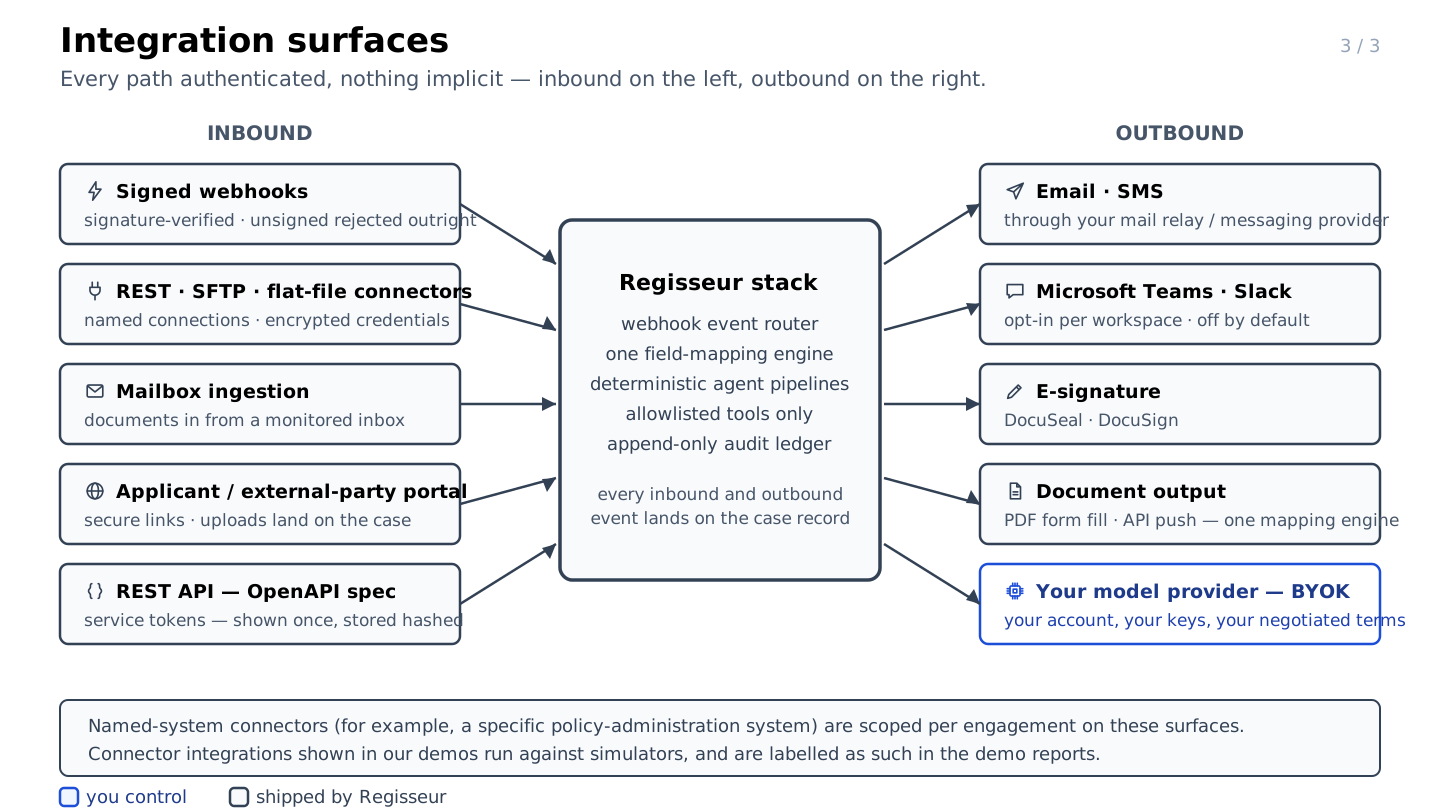
Webhooks and event sources (HRIS, ServiceNow, messaging, and more) start the right case automatically, the trigger payload mapped onto case data from the first moment.
Cases reach out over email and SMS through your own providers; message-correlated replies route back to the right case.
When a case is waiting on an outside party, an autonomous follow-up agent chases the response on a schedule (under review where review is required).
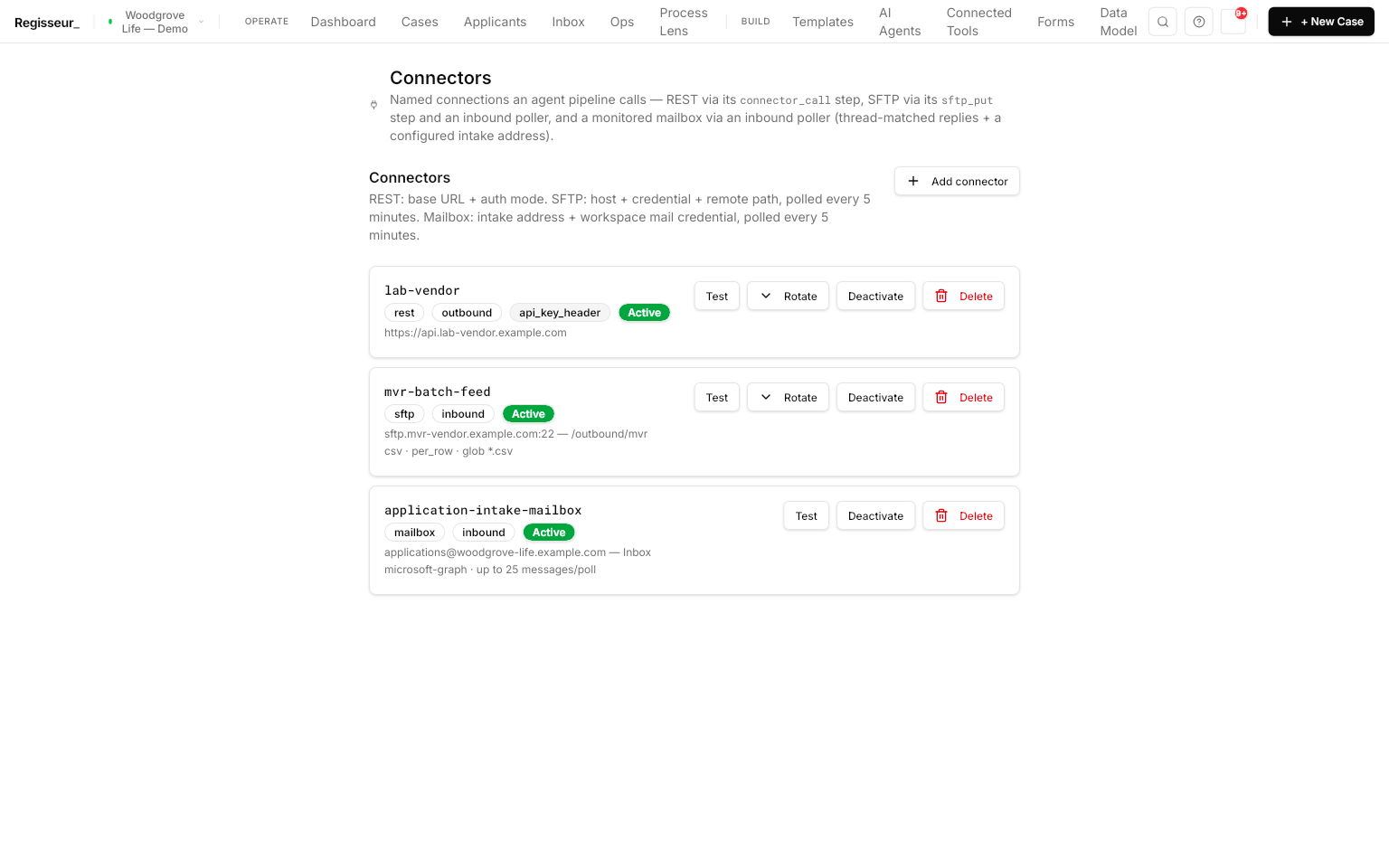
Modern systems get MCP and REST. Thirty-year-old systems get SFTP and a mailbox. Both are first-class: named, credentialed connections, without code.
Generic REST connections to any HTTP system, configured, credentialed, and tested per workspace, with no integration to build.
Every call is workspace-scoped and audited at the call site.
The format legacy systems actually speak: CSV and fixed-width files over SFTP, inbound and outbound.
Records map onto typed case attributes on the way in; generated files on the way out.
Point a process at a mailbox and it starts the moment a message arrives, the email parsed into a structured case.
Replies correlate back to the case that sent them.
Bring one process, the systems it touches, provider requirements, and the review gates that keep it safe. We’ll sketch the MCP registry, the provider layer, the autonomy ceilings, and the first workflow you could run by week four.